College Costs 2026: State Breakdown & 15% Savings Guide

Anúncios
Understanding the projected college costs in 2026, including a detailed state-by-state breakdown and practical strategies to reduce expenses by at least 15%, is crucial for future students and families planning for higher education.
Are you wondering about the cost of college in 2026 and how it might impact your future or your family’s? The landscape of higher education finance is constantly evolving, making it essential for prospective students and their families to understand the financial commitments involved. Planning ahead can make a significant difference, not just in managing expenses but also in identifying opportunities to reduce the overall cost of a college degree.
Anúncios
The evolving landscape of college costs
The cost of higher education in the United States has been a persistent concern for decades, and 2026 is projected to continue this trend of rising expenses. Tuition, fees, room, and board represent a substantial investment, often requiring careful financial planning. Understanding the various factors that contribute to these costs is the first step toward developing effective strategies to mitigate them.
Anúncios
Several elements influence the overall price tag of a college education. Institutional reputation, program specialization, and the type of institution (public vs. private) all play significant roles. For example, highly specialized programs at prestigious private universities often come with a higher price. Moreover, the state in which a university is located can dramatically affect in-state versus out-of-state tuition rates, creating complex financial scenarios for families.
Key drivers of rising tuition
- Operational expenses: Universities face increasing costs for faculty salaries, administrative staff, technology infrastructure, and maintaining state-of-the-art facilities.
- Decreased state funding: Many public institutions have seen a reduction in state appropriations, leading them to rely more heavily on tuition revenue to cover their budgets.
- Demand for amenities: Students often seek modern dorms, recreation centers, and diverse campus services, which add to the operational costs that are ultimately passed on to students.
- Financial aid expansion: While beneficial, the growth of institutional financial aid programs can sometimes contribute to higher sticker prices, as institutions adjust their budgets to accommodate these commitments.
These drivers collectively create a challenging environment for students, but they also underscore the importance of proactive financial planning. By understanding where the costs come from, families can better anticipate their financial obligations and seek out institutions that align with both their academic goals and their budget.
State-by-state breakdown of projected costs for 2026
The variation in college costs across different states is one of the most critical aspects of planning for higher education. What might be affordable in one state could be prohibitively expensive in another. This section provides a generalized overview of projected trends, emphasizing that individual institutional costs will vary.
States with historically lower tuition rates, often in the Midwest or Southern regions, may continue to offer more affordable public university options. Conversely, states with a high cost of living, particularly on the East and West Coasts, typically feature higher tuition and living expenses. These regional differences are not static; economic conditions and state-level education policies can cause shifts year to year.
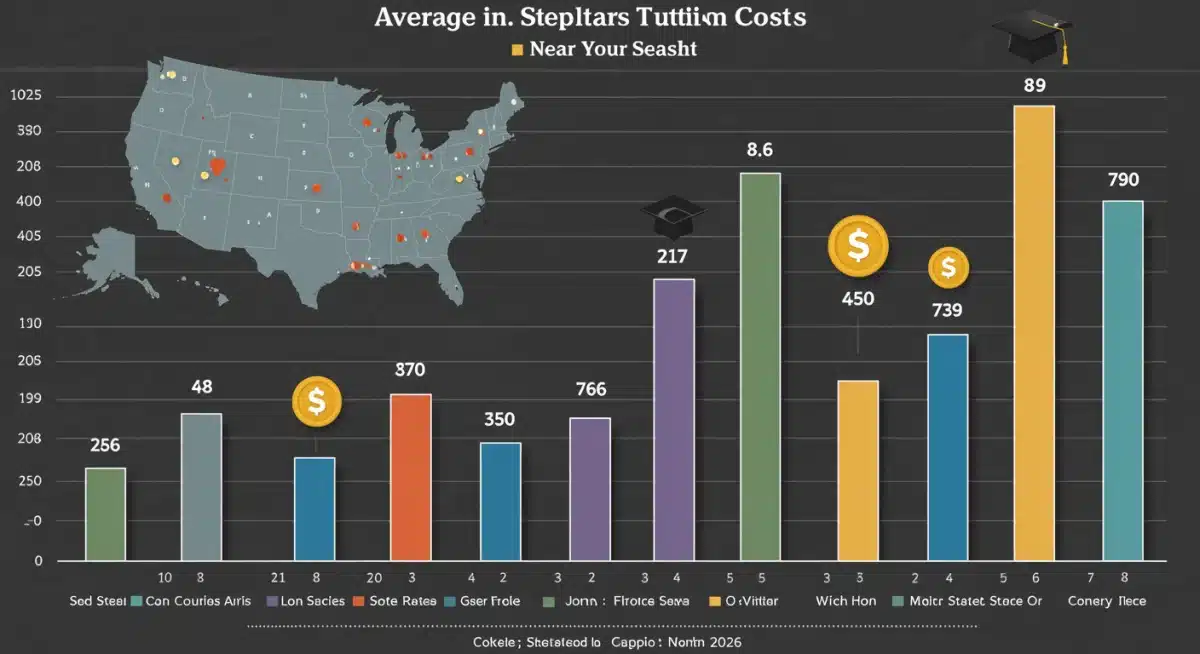
For instance, states like Wyoming and North Dakota consistently rank among the most affordable for in-state tuition, while states such as Vermont and New Hampshire often feature some of the highest. California and New York, despite having extensive public university systems, can also have significant costs, especially for out-of-state students or those attending private institutions.
Regional cost variations and what they mean for you
- Northeast: Generally higher costs, particularly for private institutions, but also home to many top-tier universities with substantial financial aid resources.
- Midwest: Often more affordable public university options, with a good balance of quality and cost-effectiveness.
- South: A mix of affordable and moderately priced institutions, with increasing investment in higher education in some states.
- West: High costs in states like California, but also more affordable options in states such as Utah and Arizona, especially for in-state residents.
When considering different states, it is crucial to research specific institutions and their projected costs for 2026. Many universities release their tuition schedules well in advance, and online tools can help estimate living expenses. This detailed research allows prospective students to compare options effectively and identify states that align with their financial capabilities.
Strategies to reduce college expenses by 15%
Achieving a 15% reduction in college expenses might seem challenging, but with strategic planning and diligent effort, it is entirely attainable. This reduction can come from various avenues, including tuition savings, housing adjustments, and intelligent financial aid utilization. The key is to explore every possible option and combine multiple strategies for maximum impact.
One of the most direct ways to reduce tuition costs is by opting for in-state public universities if you are a resident. The difference between in-state and out-of-state tuition can easily exceed 50%, immediately putting a significant dent in overall expenses. Furthermore, attending a community college for the first two years and then transferring to a four-year institution can save tens of thousands of dollars.
Leveraging financial aid and scholarships
- FAFSA completion: Completing the Free Application for Federal Student Aid (FAFSA) is paramount. It determines your eligibility for federal grants, work-study programs, and federal student loans.
- Scholarship search: Actively seek out scholarships from various sources—colleges, private organizations, community groups, and even employers. Every scholarship awarded directly reduces the amount you need to borrow or pay out of pocket.
- Merit aid: Many institutions offer merit-based scholarships based on academic achievement, leadership, or specific talents. These often do not depend on financial need.
Beyond traditional financial aid, consider alternative housing options. Living at home for a year or two, if feasible, can save thousands in room and board. Exploring off-campus housing with roommates can also be significantly cheaper than university dorms. These seemingly small adjustments accumulate to substantial savings over a four-year degree.
Maximizing grants and scholarships opportunities
Grants and scholarships are essentially free money for college that does not need to be repaid. Maximizing these opportunities is perhaps the most impactful way to reduce your overall college expenses. The process requires thorough research, timely applications, and often, a compelling personal narrative.
Start your scholarship search early, ideally during your junior year of high school. Many scholarships have application deadlines months before college application deadlines. Websites like Fastweb, College Board, and Scholarship.com are excellent resources, but also investigate local community foundations, religious organizations, and professional associations related to your intended major.
Tips for securing more aid
- Craft strong essays: Many scholarships require essays. Personalize them, highlight your unique experiences, and clearly articulate your goals and why you deserve the scholarship.
- Maintain a high GPA: Academic excellence opens doors to merit-based scholarships directly from universities and various private organizations.
- Participate in extracurriculars: Leadership roles, volunteer work, and participation in clubs can demonstrate well-roundedness and commitment, which many scholarship committees value.
- Seek out niche scholarships: Don’t overlook smaller, less competitive scholarships. These can add up quickly and are often easier to obtain. Think about unique talents, heritage, or specific interests you possess.
Remember that some scholarships are renewable, meaning they can provide funding for multiple years. Understanding the renewal criteria, such as maintaining a certain GPA, is vital. Every dollar secured through grants and scholarships is a dollar you don’t have to earn or borrow, making a direct impact on your financial burden.
Smart borrowing: Federal vs. private loans
For many students, some form of borrowing is inevitable to cover the remaining gap after grants and scholarships. However, not all loans are created equal. Understanding the differences between federal and private student loans is crucial for making informed decisions that minimize long-term financial strain.
Federal student loans generally offer more favorable terms, including fixed interest rates, income-driven repayment plans, and options for deferment or forbearance in times of financial hardship. They also do not require a co-signer and often have lower interest rates than private options. The two main types are Direct Subsidized Loans (for students with financial need, where the government pays interest while in school) and Direct Unsubsidized Loans.
Key differences and considerations
- Interest rates: Federal loans typically have lower, fixed interest rates. Private loans often have variable rates that can increase over time, making repayment unpredictable.
- Repayment flexibility: Federal loans offer various repayment plans, including those based on your income. Private loan repayment terms are generally less flexible.
- Borrower protections: Federal loans come with more borrower protections, such as deferment options and loan forgiveness programs for certain professions. Private loans offer fewer such safeguards.
- Credit checks: Federal loans generally do not require a credit check for most undergraduates. Private loans are credit-based and often require a co-signer, especially for younger borrowers with limited credit history.
If you must borrow, prioritize federal loans first, maxing out your eligibility before considering private options. Only take out what you absolutely need, as every dollar borrowed accrues interest and must be repaid. Research different private lenders if you need to go that route, comparing interest rates, fees, and repayment terms carefully.
Beyond tuition: Reducing living and personal expenses
While tuition and fees are significant, living and personal expenses can account for a substantial portion of the total cost of college. These often overlooked categories present numerous opportunities for savings that can contribute significantly to your 15% reduction goal. Effective budgeting and mindful spending are key to managing these costs.
Housing is typically the largest non-tuition expense. As mentioned, living at home or choosing off-campus housing with roommates can offer considerable savings. Beyond housing, consider transportation. If possible, choose a college accessible by public transport or one where walking or biking is feasible, reducing reliance on a personal car, which comes with fuel, insurance, and maintenance costs.
Practical tips for daily savings
- Cook at home: Eating out frequently adds up quickly. Learn to cook simple, healthy meals to save money on food.
- Buy used textbooks: Textbooks can be incredibly expensive. Look for used copies, rent them, or explore digital versions to cut costs.
- Student discounts: Many businesses offer discounts to students on everything from software to entertainment. Always ask!
- Part-time jobs: A part-time job can help cover daily expenses and reduce the need for additional loans. Look for work-study programs if eligible.
- Budgeting apps: Utilize budgeting tools or apps to track your spending and identify areas where you can cut back.
These strategies, when combined, can create a powerful financial buffer, allowing you to focus more on your studies and less on financial stress. Every small saving contributes to the larger goal of making college more affordable and reducing your overall debt burden after graduation.
Planning for 2026 and beyond: A holistic approach
Successfully navigating the cost of college in 2026 will undoubtedly present challenges, but with a well-informed and strategic approach, prospective students and their families can significantly manage and even reduce their educational expenses. By understanding state-by-state variations, aggressively pursuing financial aid, making smart borrowing choices, and diligently controlling living costs, achieving a quality higher education remains an attainable goal. Proactive planning is not just advisable; it is essential for securing a financially sound academic future.
Long-term financial wellness
- Financial literacy: Educate yourself on personal finance, budgeting, and debt management. These skills are invaluable for college and beyond.
- Career planning: Choose a major and career path that aligns with your interests and offers reasonable job prospects and earning potential to facilitate loan repayment.
- Post-graduation budgeting: Plan for life after college, including student loan repayment strategies, even before you graduate.
Ultimately, a college education is an investment. By taking a comprehensive approach to managing its costs, you can ensure that this investment yields the best possible returns without creating an overwhelming financial burden. The goal is to gain a valuable education without sacrificing your financial future.
| Key Strategy | Brief Description |
|---|---|
| Maximize Financial Aid | Complete FAFSA early and actively seek all available grants and scholarships to avoid loans. |
| Consider Community College | Start at a community college for general education courses, then transfer to a four-year institution to save significantly. |
| Smart Borrowing | Prioritize federal student loans over private loans due to better terms and borrower protections. |
| Reduce Living Expenses | Explore options like living at home, off-campus housing with roommates, and cooking meals to save on daily costs. |
Frequently asked questions about college costs in 2026
While precise figures are difficult to predict, tuition is expected to continue its upward trend, likely increasing by 2-4% annually. This projection is influenced by inflation, institutional operational costs, and state funding policies. This means a significant rise from current costs, making early financial planning crucial for families.
Not necessarily. While private colleges often have higher sticker prices, they frequently offer more substantial institutional grants and scholarships. This can sometimes make the net cost of a private institution comparable to, or even lower than, an out-of-state public university for certain students. Always compare net costs, not just sticker prices.
The Free Application for Federal Student Aid (FAFSA) is the primary form used to determine eligibility for federal student aid, including grants, work-study, and federal loans. It is vital to complete it annually as early as possible (usually October 1st) for the 2026-2027 academic year to maximize your chances of receiving aid.
Attending part-time can reduce your per-semester tuition costs, but it may extend your time to graduation, potentially increasing overall living expenses and delaying entry into the workforce. It can be a viable option for some, especially if combined with working, but it requires careful consideration of the long-term financial implications and aid eligibility.
To save on textbooks, consider buying used copies, renting them online or from campus bookstores, and exploring digital versions or open educational resources (OER). Many university libraries also have copies available for short-term loan. Planning ahead and comparing prices from various vendors can lead to significant savings.
Conclusion
Navigating the cost of college in 2026 will undoubtedly present challenges, but with a well-informed and strategic approach, prospective students and their families can significantly manage and even reduce their educational expenses. By understanding state-by-state variations, aggressively pursuing financial aid, making smart borrowing choices, and diligently controlling living costs, achieving a quality higher education remains an attainable goal. Proactive planning is not just advisable; it is essential for securing a financially sound academic future.