Fed Rate Projections: Next 6 Months Explained
Anúncios
The Federal Reserve’s interest rate projections for the next six months are crucial for economic stability, influenced by inflation, employment, and global events, directly impacting borrowing costs and investment decisions for businesses and consumers.
Anúncios
Understanding the Federal Reserve’s Interest Rate Projections for the Next 6 Months (RECENT UPDATES) is essential for anyone navigating the complex world of finance. These projections, often seen as a barometer for the future economic climate, influence everything from mortgage rates to business investments. Staying informed about the Fed’s outlook is not just for economists; it’s vital for every American household and enterprise.
Anúncios
The Federal Reserve’s Mandate and Tools
The Federal Reserve, often simply called the Fed, operates with a dual mandate: to achieve maximum employment and maintain price stability. These two goals guide its monetary policy decisions, particularly regarding interest rates. Understanding how the Fed interprets these mandates and the tools it employs is fundamental to grasping its future actions.
Historically, the Fed has adjusted the federal funds rate – the target rate for overnight borrowing between banks – as its primary tool. Changes to this rate ripple through the entire financial system, affecting other interest rates like those on mortgages, car loans, and credit cards. When the Fed raises rates, borrowing becomes more expensive, which can cool down an overheating economy and curb inflation. Conversely, lowering rates makes borrowing cheaper, stimulating economic activity during downturns.
Key Monetary Policy Tools
- Federal Funds Rate: The primary tool for influencing the cost and availability of money in the economy.
- Quantitative Easing/Tightening: Large-scale asset purchases or sales to influence long-term interest rates and market liquidity.
- Reserve Requirements: The amount of funds banks must hold in reserve, though less frequently used now.
Beyond these conventional tools, the Fed also communicates its intentions through forward guidance, providing insights into its future policy path. This transparency aims to reduce market uncertainty and guide expectations, which in turn can influence current economic behavior. The Fed’s statements and the “dot plot” – a graphical representation of individual FOMC members’ projections for future interest rates – are closely watched by analysts worldwide.
In conclusion, the Federal Reserve’s role extends far beyond setting a single rate. Its comprehensive approach to monetary policy, guided by its dual mandate and executed through various tools and communication strategies, is designed to foster a healthy and stable economic environment. These actions are constantly evolving in response to economic data and global conditions.
Current Economic Landscape: Inflation and Employment
The current economic landscape is characterized by a delicate balance between persistent inflation and a robust, though evolving, labor market. These two factors are paramount in the Federal Reserve’s deliberations on interest rate policy. Recent data releases have painted a mixed picture, creating a challenging environment for policymakers.
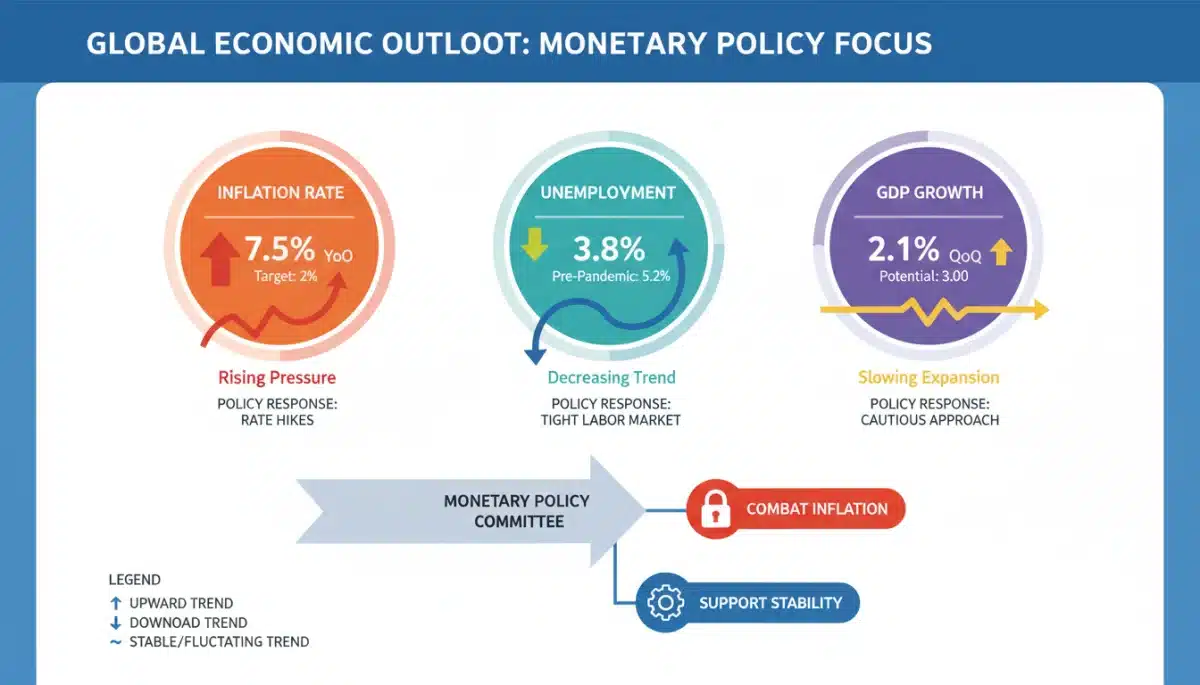
Inflation, while showing signs of moderating from its peak, remains above the Fed’s long-term target of 2%. Supply chain disruptions, geopolitical events, and strong consumer demand have all contributed to upward price pressures. The Fed is closely monitoring various inflation metrics, including the Consumer Price Index (CPI) and the Personal Consumption Expenditures (PCE) price index, the latter being its preferred gauge.
Analyzing Inflationary Pressures
- Sticky Inflation Components: Services inflation, particularly housing and labor-intensive sectors, has proven more persistent.
- Wage Growth: Strong wage growth, while beneficial for workers, can also contribute to inflationary pressures if not matched by productivity gains.
- Energy and Food Prices: Volatile global commodity markets can introduce significant, albeit often temporary, inflationary spikes.
On the employment front, the U.S. labor market has demonstrated remarkable resilience. Unemployment rates have remained historically low, and job growth, while cooling, continues to be solid. However, the Fed is also attentive to signs of labor market rebalancing, such as a decline in job openings and a more balanced supply-demand dynamic for workers. A tight labor market can fuel wage-price spirals, complicating the fight against inflation.
The interplay between these two forces is critical. If inflation remains stubbornly high despite a cooling labor market, the Fed might feel compelled to maintain a restrictive stance for longer. Conversely, a rapid deceleration in employment combined with falling inflation could prompt a shift towards more accommodative policies. The Fed’s decisions are data-dependent, making each new economic report a significant event for market participants.
Understanding the Fed’s “Dot Plot” and Forward Guidance
One of the most anticipated components of the Federal Reserve’s quarterly meetings is the release of the “dot plot.” This chart graphically represents each Federal Open Market Committee (FOMC) participant’s projection for the appropriate level of the federal funds rate at the end of the current year and for the next few years, as well as in the longer run. It offers a unique, albeit anonymized, glimpse into the individual expectations of the policymakers.
While the dot plot does not represent a committee decision or a commitment to a future path, it provides valuable insights into the collective thinking of the FOMC. Market participants scrutinize the median dot, as well as the dispersion of the dots, to gauge the likely direction and speed of future interest rate adjustments. A tighter cluster of dots suggests greater consensus among members, while a wider spread indicates more divergent views on the economic outlook and appropriate policy response.

The Role of Forward Guidance
- Clarity and Expectations: Forward guidance aims to provide clarity on the Fed’s future policy intentions, helping to anchor market expectations.
- Market Influence: By signaling future actions, the Fed can influence long-term interest rates and financial conditions even before making actual policy changes.
- Data Dependence: The effectiveness and credibility of forward guidance rely heavily on the Fed’s commitment to being data-dependent, adjusting its guidance as economic conditions evolve.
Forward guidance, delivered through official statements, press conferences, and speeches, complements the dot plot by offering qualitative context. It explains the economic conditions that would likely trigger a policy shift, such as sustained progress towards the Fed’s inflation and employment goals. This combination of quantitative projections and qualitative communication is crucial for managing market expectations and ensuring the smooth implementation of monetary policy.
In essence, both the dot plot and forward guidance are powerful communication tools that the Federal Reserve employs to steer the economy. They help market participants, businesses, and consumers anticipate future policy moves, enabling them to make more informed financial decisions in a landscape shaped by the Fed’s influence.
Factors Influencing Rate Decisions for the Next 6 Months
The Federal Reserve’s interest rate decisions over the next six months will be a culmination of various interconnected economic indicators and global developments. No single factor dictates policy; rather, it is a holistic assessment of the economic health and future trajectory of the United States.
Chief among these factors is the path of inflation. The Fed will be closely watching whether core inflation, which excludes volatile food and energy prices, continues its downward trend. Evidence of sustained disinflation, particularly in the services sector, would provide policymakers with greater comfort to potentially pause or even consider rate cuts. Conversely, a resurgence in inflationary pressures could necessitate further tightening.
Key Influential Factors
- Inflation Data: Monthly CPI and PCE reports, focusing on core inflation and wage growth.
- Employment Figures: Unemployment rate, job creation numbers, wage growth, and labor force participation.
- Economic Growth: GDP reports, consumer spending, business investment, and manufacturing data.
- Global Economic Conditions: Geopolitical stability, international trade, and economic performance of major trading partners.
The strength of the labor market will also play a pivotal role. While a strong job market is generally desirable, an excessively tight one can contribute to wage inflation. The Fed will be looking for signs of a healthy rebalancing, where job openings align more closely with available workers without leading to significant increases in unemployment. The pace of wage growth will be particularly scrutinized as a potential driver of future inflation.
Beyond domestic data, global economic conditions and geopolitical stability can significantly influence the Fed’s outlook. Supply chain resilience, energy prices, and the economic performance of key trading partners all have implications for U.S. inflation and growth. A global slowdown, for example, could dampen demand and ease inflationary pressures, while new geopolitical tensions could create upward price shocks.
Ultimately, the Fed’s decisions will hinge on its assessment of whether monetary policy is sufficiently restrictive to bring inflation back to target without causing an undue slowdown in economic activity. The next six months will be a critical period for observing these dynamics and understanding the Fed’s response.
Potential Scenarios for Interest Rate Adjustments
Given the dynamic economic environment, several potential scenarios for the Federal Reserve’s interest rate adjustments could unfold over the next six months. Each scenario is contingent upon the evolution of key economic indicators, primarily inflation and employment.
One scenario involves a “higher for longer” approach, where the Fed maintains current interest rates or even implements a small additional hike if inflation proves more persistent than anticipated. This would occur if core inflation remains sticky, wage growth stays elevated, and economic activity shows surprising resilience, suggesting that the current policy stance isn’t restrictive enough to achieve the 2% inflation target within a reasonable timeframe. This could lead to a prolonged period of elevated borrowing costs.
Possible Rate Path Scenarios
- Hold Steady: If inflation continues to moderate gradually and the labor market shows signs of rebalancing without significant distress.
- Further Hike: If inflation reaccelerates or remains stubbornly high, requiring more restrictive monetary policy.
- Rate Cuts: If inflation falls sharply towards target and/or the economy experiences a significant downturn or recession.
Alternatively, a scenario of “rate cuts” could emerge if the economy experiences a more rapid deceleration or even enters a recession, coupled with a swift return of inflation towards the Fed’s target. In this situation, the Fed might pivot to lowering rates to stimulate economic activity and prevent a severe downturn. Such a move would aim to ease financial conditions, making borrowing cheaper for businesses and consumers, thereby encouraging investment and spending.
A third plausible scenario is a “pause and assess” approach, where the Fed holds rates steady for an extended period. This would likely happen if inflation continues its gradual decline towards the target, and the labor market shows signs of cooling without a sharp increase in unemployment. In this scenario, the Fed would monitor incoming data closely, allowing the cumulative effect of past rate hikes to fully transmit through the economy before making further adjustments.
These scenarios are not mutually exclusive and the Fed’s ultimate path will likely involve elements of adaptation based on incoming data. The next six months will be characterized by a careful balancing act, with policymakers weighing the risks of over-tightening against the dangers of premature easing.
Impact on Consumers and Businesses
The Federal Reserve’s interest rate projections and subsequent actions have profound and far-reaching impacts on both consumers and businesses across the United States. These effects permeate various aspects of daily financial life and strategic business planning.
For consumers, changes in interest rates directly influence borrowing costs. Higher rates mean more expensive mortgages, car loans, and credit card debt. This can reduce discretionary spending power, as a larger portion of income goes towards debt servicing. Conversely, lower rates can make these loans more affordable, potentially stimulating consumer demand for big-ticket items. Savings accounts and Certificates of Deposit (CDs) also see their yields adjust, affecting how much individuals earn on their deposits.
Consumer and Business Repercussions
- Borrowing Costs: Directly impacts mortgage rates, auto loans, credit card APRs for consumers; and business loans, lines of credit for companies.
- Investment Decisions: Influences stock market performance, bond yields, and real estate investment attractiveness.
- Economic Growth: Higher rates can slow down economic activity to curb inflation, while lower rates aim to stimulate growth.
Businesses, from small startups to large corporations, are equally affected. Higher interest rates increase the cost of borrowing capital for expansion, inventory, and operations, potentially slowing down investment and hiring. Small businesses, often more reliant on variable-rate loans, can feel the pinch more acutely. Larger corporations might find it more expensive to issue new bonds, impacting their capital structure and growth strategies.
The housing market is particularly sensitive to interest rate changes. Rising mortgage rates can cool demand, making homeownership less affordable and potentially leading to a slowdown in sales and price appreciation. This has ripple effects on related industries, such as construction and real estate services. Similarly, investment decisions are influenced; higher rates can make bonds more attractive relative to stocks, potentially shifting capital flows.
In summary, the Fed’s interest rate policy is a critical determinant of economic conditions for both individuals and companies. Understanding these impacts allows for better financial planning and strategic decision-making in an economy highly responsive to monetary policy shifts.
Market Expectations and Analyst Forecasts
Market expectations and analyst forecasts are critical components in understanding the Federal Reserve’s likely trajectory for interest rates over the next six months. While the Fed aims for transparency, market participants and economic analysts constantly interpret incoming data and Fed communications to form their own projections, which in turn influence market behavior.
Financial markets, particularly the futures markets for the federal funds rate, provide real-time probabilities of future rate hikes or cuts. These probabilities are derived from the pricing of contracts that mature on specific dates, reflecting the collective wisdom of traders and investors. A high probability of a rate hike, for example, often leads to an immediate adjustment in bond yields and other interest-sensitive assets.
Key Market Indicators and Analyst Insights
- Federal Funds Futures: Provides real-time probabilities for future Fed rate changes.
- Bond Market Yields: Especially the 2-year and 10-year Treasury yields, which often reflect expectations for short-term and long-term economic growth and inflation.
- Equity Market Performance: Often reacts to perceived changes in future interest rates, with growth stocks particularly sensitive.
Economists and financial analysts from various institutions also publish their forecasts, often differing in their outlook due to varying interpretations of data and economic models. These forecasts are typically based on a deep dive into inflation trends, employment reports, GDP growth, and global economic factors. Divergences in these forecasts can create market volatility as investors weigh conflicting expert opinions.
It’s important to note that market expectations and analyst forecasts are not always perfectly aligned with the Fed’s ultimate decisions. Unexpected economic data or shifts in the Fed’s assessment can lead to surprises, causing significant market movements. However, these forecasts serve as valuable benchmarks for understanding the prevailing sentiment and potential pathways for monetary policy.
In conclusion, monitoring market expectations and analyst forecasts provides a crucial external perspective on the Federal Reserve’s likely actions. While the Fed maintains its independence, the interplay between its communications and market interpretations shapes the financial landscape for the coming months.
| Key Point | Brief Description |
|---|---|
| Fed’s Dual Mandate | Maximum employment and price stability guide all interest rate decisions. |
| Inflation & Employment | Core economic indicators heavily influencing future rate adjustments. |
| Dot Plot & Guidance | Tools for communicating FOMC members’ rate expectations and policy intentions. |
| Economic Impact | Rate changes directly affect consumer borrowing, business investment, and market stability. |
Frequently Asked Questions About Fed Rates
The Federal Funds Rate is the target interest rate set by the FOMC for overnight borrowing and lending between banks. It serves as a benchmark for other interest rates throughout the economy, influencing everything from mortgages to credit card rates.
The Federal Open Market Committee (FOMC) typically meets eight times per year, approximately every six weeks, to assess economic conditions and determine the appropriate stance of monetary policy, including interest rate decisions.
The ‘dot plot’ is a chart showing individual FOMC members’ projections for the federal funds rate. It’s important because it provides insight into policymakers’ expectations for future rate paths, helping markets anticipate potential Fed actions.
Changes in the Federal Funds Rate influence mortgage rates. When rates rise, new mortgages and adjustable-rate mortgages become more expensive. Conversely, falling rates can lead to lower payments or opportunities for refinancing for homeowners.
The Fed prioritizes inflation data (like CPI and PCE), employment figures (unemployment rate, job growth), and indicators of economic growth (GDP, consumer spending) to guide its monetary policy decisions and achieve its dual mandate.
Conclusion
The Federal Reserve’s interest rate projections for the next six months are a linchpin of economic stability and growth. These decisions, driven by a meticulous assessment of inflation, employment, and global factors, directly influence the financial landscape for every American. Staying informed about the Fed’s communications, understanding its tools, and recognizing the potential scenarios for rate adjustments empowers both consumers and businesses to make more strategic financial choices. The coming months will undoubtedly be a period of careful observation and adaptation as the Fed navigates its dual mandate in a constantly evolving economic environment.