Dependent Care FSAs 2026: Save Up to $5,000 on Childcare

Anúncios
Dependent Care Flexible Spending Accounts (FSAs) in 2026 offer a powerful way for working parents to save up to $5,000 tax-free on eligible childcare expenses, providing substantial financial relief.
Navigating the rising costs of childcare can be a significant financial challenge for many families. Fortunately, understanding and utilizing a Dependent Care FSA for 2026 can offer a substantial financial advantage, potentially saving you up to $5,000 in tax-free dollars on eligible expenses.
Anúncios
Understanding Dependent Care FSAs for 2026
Dependent Care Flexible Spending Accounts (FSAs) are employer-sponsored benefit plans that allow employees to set aside pre-tax money from their paychecks to cover eligible dependent care expenses. This means the money you contribute is not subject to federal income tax, Social Security, or Medicare taxes, leading to significant savings.
Anúncios
For 2026, the maximum contribution limit for Dependent Care FSAs is expected to remain at $5,000 per household for single filers and married couples filing jointly, or $2,500 for married individuals filing separately. This tax-advantaged account is designed to ease the financial burden on working parents and guardians who need care for their children or other qualifying dependents to allow them to work.
What Makes an Expense Eligible?
Understanding which expenses qualify is crucial to maximizing your Dependent Care FSA benefits. The IRS has specific guidelines, but generally, expenses must be for the care of a qualifying individual to enable you (and your spouse, if married) to work or look for work.
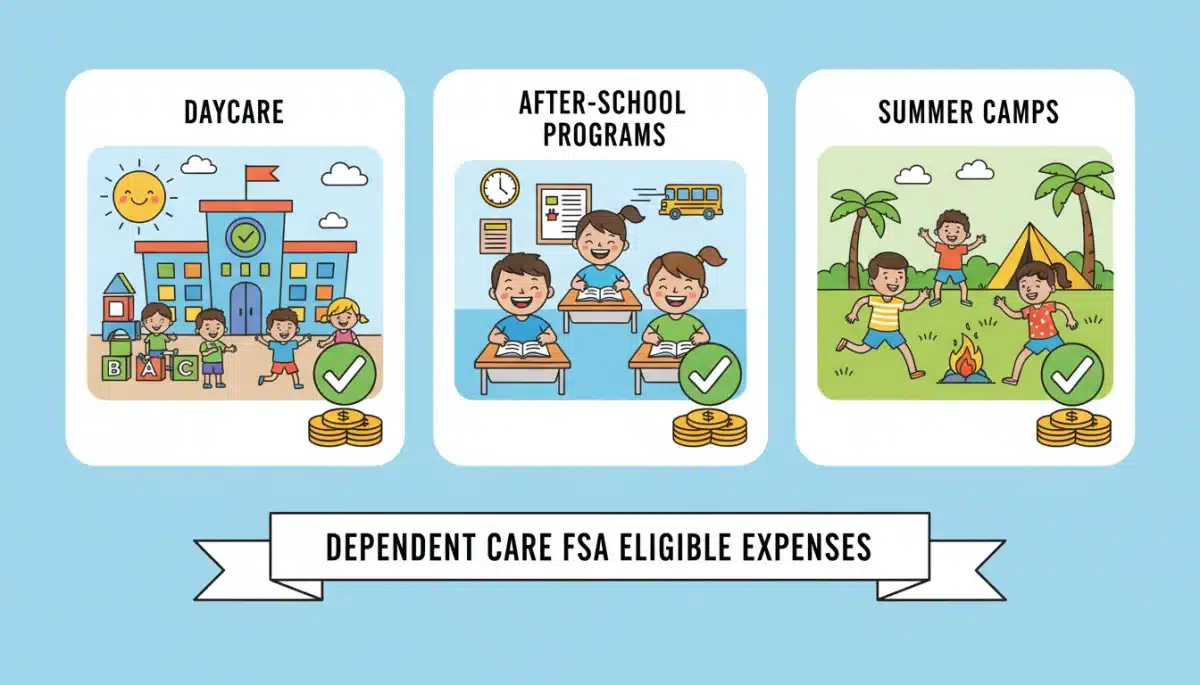
- Daycare and Preschool: Costs associated with licensed daycare centers and accredited preschool programs are typically eligible.
- After-School Programs: Fees for programs that care for your child after school hours while you are working.
- Summer Day Camps: Expenses for day camps (not overnight camps) during school breaks can be covered.
- In-Home Care: Wages paid to nannies, au pairs, or babysitters providing care in your home, provided they are not your spouse or child under 19.
It’s important to note that expenses like tuition for kindergarten or higher grades, medical care, or food costs (unless inseparable from the care) are generally not eligible. Always verify with your plan administrator and IRS guidelines for the most accurate information.
In essence, Dependent Care FSAs provide a powerful mechanism for families to reduce their taxable income while ensuring their dependents receive necessary care. Planning your contributions carefully based on your anticipated expenses is key to fully leveraging this valuable benefit.
Who Qualifies for a Dependent Care FSA?
Eligibility for a Dependent Care FSA hinges on both the employee’s work status and the dependent’s qualifications. This benefit is specifically designed for individuals who incur care expenses to allow them (and their spouse, if applicable) to work, actively look for work, or attend school full-time.
To qualify, you must be employed by a company that offers a Dependent Care FSA. Your dependent must also meet certain criteria. The most common qualifying dependent is a child under the age of 13. However, it can also include a spouse or other dependent who is physically or mentally incapable of self-care and lives with you for more than half the year.
Dependent Criteria for Eligibility
The IRS sets clear definitions for who can be considered a qualifying dependent for these accounts. It’s not just about age; it’s about the need for care to enable the primary earner(s) to maintain employment.
- Children Under 13: Your child (or stepchild, foster child, or adopted child) must be under the age of 13 at the time the care is provided.
- Incapable of Self-Care: A spouse or other dependent who is physically or mentally unable to care for themselves, regardless of age, can qualify if they live with you and you provide more than half of their support.
- Living with You: The qualifying individual must live in your home for more than half the year.
Both you and your spouse (if married) must be working, actively looking for work, or a full-time student to qualify for the Dependent Care FSA. There are exceptions for a spouse who is a full-time student or is disabled. Understanding these rules ensures you maximize your benefits without running into compliance issues.
Ensuring both your employment status and your dependent’s status align with the IRS guidelines is the first step in successfully utilizing a Dependent Care FSA. This benefit is a powerful tool for families balancing work and caregiving responsibilities.
Maximizing Your Savings: The $5,000 Advantage
The primary appeal of a Dependent Care FSA is the substantial tax savings it offers. By contributing pre-tax dollars, you effectively reduce your taxable income, which can lead to significant savings on federal, state (in most cases), and payroll taxes. For many families, this translates into hundreds or even thousands of dollars annually.
For 2026, the maximum contribution limit is $5,000 for a single person or a married couple filing jointly, and $2,500 for married individuals filing separately. This $5,000 limit represents the maximum amount of pre-tax money you can set aside for eligible dependent care expenses. The actual amount you save depends on your tax bracket.
Calculating Your Potential Tax Savings
Let’s consider an example: if you contribute the full $5,000 to your Dependent Care FSA and are in a 22% federal income tax bracket, plus paying 7.65% in FICA taxes (Social Security and Medicare), your total tax savings could be substantial. You’d save 22% of $5,000 ($1,100) in federal income tax and 7.65% of $5,000 ($382.50) in FICA taxes, totaling $1,482.50. This doesn’t even include potential state tax savings, which vary by state.
- Federal Income Tax Savings: Reduces your taxable income dollar-for-dollar by your contribution amount.
- FICA Tax Savings: Exempts your contributions from Social Security and Medicare taxes.
- State Tax Savings: Many states also exempt FSA contributions from state income tax, further enhancing your savings.
This tax-free approach to paying for childcare makes a Dependent Care FSA one of the most effective ways to reduce your overall family expenses. It’s essentially getting a discount on your childcare costs, paid for by the government in the form of tax relief.
By strategically planning your contributions, families can significantly offset the high costs of childcare. The $5,000 limit, when fully utilized, provides a tangible and substantial financial advantage, making it a cornerstone of smart financial planning for working parents.
Comparing Dependent Care FSA with Child and Dependent Care Credit
When planning for childcare expenses, it’s essential to understand the difference between a Dependent Care FSA and the Child and Dependent Care Credit. While both aim to provide financial relief for families, they operate differently and often cannot be used for the same expenses, leading to a choice that can impact your overall savings.
The Child and Dependent Care Credit is a tax credit you claim when you file your federal income taxes. It directly reduces your tax liability based on a percentage of your eligible childcare expenses. The percentage and maximum expenses vary based on your Adjusted Gross Income (AGI).
Key Differences and How to Choose
The main distinction lies in how the benefit is applied. An FSA reduces your taxable income upfront, providing immediate tax savings on each paycheck. The tax credit, however, is applied at the end of the year when you file your taxes. For many, the pre-tax savings of an FSA are more advantageous.
- Pre-tax vs. Tax Credit: FSA contributions are pre-tax, reducing your gross income. The tax credit reduces your tax bill directly after calculating your income.
- Contribution Limits: FSA has a $5,000 limit (for most). The credit’s maximum expenses are typically $3,000 for one dependent and $6,000 for two or more.
- Income Phase-Outs: The Child and Dependent Care Credit has income phase-outs that reduce the credit’s value for higher earners. FSAs are not subject to these phase-outs, making them beneficial across a wider income range.
- Use It or Lose It: FSAs generally operate on a “use it or lose it” basis, meaning funds not used by the end of the plan year (with some grace period exceptions) are forfeited. The tax credit, by contrast, doesn’t have this constraint.
Generally, families in higher tax brackets often find the Dependent Care FSA more beneficial due to the higher tax savings on pre-tax contributions. Families in lower tax brackets might find the tax credit more advantageous, especially if they cannot contribute the full $5,000 to an FSA. It’s often possible to use a combination of both, but you cannot use both for the same dollar of expense.
Consulting with a tax professional can help you determine the optimal strategy for your specific financial situation, ensuring you maximize your tax benefits for childcare expenses. Carefully evaluating your income, expenses, and tax bracket is crucial for making an informed decision.
Navigating Enrollment and Reimbursement in 2026
Enrolling in a Dependent Care FSA and understanding the reimbursement process are critical steps to effectively utilize this benefit. Enrollment typically occurs during your employer’s annual open enrollment period, which usually takes place in the fall for the upcoming plan year.
During open enrollment, you’ll decide how much to contribute to your FSA for the entire plan year, up to the maximum limit of $5,000. This amount is then deducted from your paychecks in equal installments throughout the year, before taxes are calculated. The “use it or lose it” rule applies, so accurate estimation of your childcare costs is important.
The Reimbursement Process
Once you incur an eligible expense, you submit a claim to your FSA administrator. This usually involves providing documentation, such as receipts or invoices from your childcare provider, detailing the service provided, the dates, and the cost. Most administrators offer online portals or mobile apps for easy claim submission.
- Submit Claims Promptly: Don’t wait until the end of the year. Submit claims regularly as expenses are incurred to ensure timely reimbursement.
- Keep Detailed Records: Maintain receipts, invoices, and any other documentation related to your childcare expenses. This is essential for claims and potential audits.
- Understand Grace Periods: Some plans offer a grace period (typically up to 2.5 months after the plan year ends) to incur expenses or a carryover option for a small amount (though less common for Dependent Care FSAs compared to Health FSAs). Confirm your plan’s specific rules.
The reimbursement process is generally straightforward once you understand your plan’s specific requirements. Funds are typically reimbursed directly to you via direct deposit or check, usually within a few business days after the claim is approved. This allows you to use your pre-tax dollars to cover your childcare costs, effectively reducing your out-of-pocket expenses.
Proactive engagement with your FSA, from careful enrollment to diligent claim submission, ensures you fully benefit from the tax advantages it offers. Staying organized and informed about your plan’s specifics will make the process smooth and hassle-free.
Planning for 2026: Key Considerations and Best Practices
As you plan your financial strategy for 2026, incorporating a Dependent Care FSA requires careful consideration to maximize its benefits. It’s not just about enrolling; it’s about strategic planning that aligns with your family’s unique needs and financial goals.
One of the most important considerations is accurately estimating your childcare expenses for the year. Overestimating can lead to forfeited funds due to the “use it or lose it” rule, while underestimating means you miss out on potential tax savings. Review your past year’s expenses and anticipate any changes, such as a child aging out of eligibility or changes in care providers.
Strategic Planning Tips for Your FSA
To make the most of your Dependent Care FSA, adopt a proactive and informed approach. This includes understanding your employer’s specific plan details and staying updated on any IRS changes that might affect eligibility or contribution limits.
- Estimate Accurately: Look at prior year expenses, factor in rate increases, and consider any changes in care needs for 2026.
- Understand Your Employer’s Plan: Some employers might offer a grace period or a limited carryover, though less common for DCFSAs. Know your plan’s specifics.
- Review IRS Guidelines: Stay informed about any updates to eligible expenses or qualifying dependent rules. The IRS website is your best resource.
- Coordinate with Spouse: If married, discuss contributions to ensure you don’t exceed the household limit and determine if an FSA or the Child and Dependent Care Credit is more beneficial for your combined income.
Consider how a Dependent Care FSA fits into your broader financial picture. Could the savings be redirected to other financial goals, like retirement planning or college savings? The tax savings from an FSA free up cash flow that can be strategically deployed elsewhere.
By adopting these best practices, families can effectively leverage Dependent Care FSAs to significantly reduce childcare costs and enhance their overall financial well-being in 2026. It’s a powerful tool for smart financial management, particularly for working parents.
Common Mistakes to Avoid with Dependent Care FSAs
While Dependent Care FSAs offer substantial benefits, certain pitfalls can diminish their value if not carefully avoided. Awareness of these common mistakes can help you navigate the system more effectively and ensure you fully realize your potential tax savings.
One of the most frequent errors is not accurately estimating annual childcare expenses. The “use it or lose it” rule means that any funds contributed but not used by the end of the plan year (or grace period, if applicable) are forfeited. This can be a costly oversight, turning potential savings into lost money.
Preventable Errors and How to Sidestep Them
Avoiding these common missteps involves careful planning, diligent record-keeping, and a clear understanding of your FSA plan’s rules. Being proactive can save you both money and frustration.
- Overcontributing: This is the classic “use it or lose it” trap. Be realistic about your childcare needs for the year. If circumstances change, you generally can’t adjust contributions mid-year unless you have a qualifying life event.
- Missing Documentation: Failing to keep detailed receipts and invoices for eligible expenses can lead to denied claims. Always get clear documentation from your childcare provider.
- Not Submitting Claims on Time: Most plans have a deadline for submitting claims after the plan year ends. Missing this deadline means you forfeit reimbursement for valid expenses.
- Confusing Eligible Expenses: Attempting to claim expenses that do not qualify (e.g., tuition for kindergarten, overnight camps) will result in denied claims and can complicate your account.
- Ignoring the Tax Credit: Not evaluating whether the Child and Dependent Care Credit might be more beneficial (or how to combine both effectively) for your specific income level can lead to missed opportunities.
Another mistake is not understanding that the Dependent Care FSA is a family limit. If both spouses have access to an FSA, their combined contributions cannot exceed the $5,000 household limit. Coordination is key to avoid exceeding this threshold.
By being vigilant and informed, you can steer clear of these common pitfalls and ensure your Dependent Care FSA truly serves as a valuable financial tool. Proper management transforms this benefit into a significant aid for managing childcare costs.
| Key Aspect | Description |
|---|---|
| Contribution Limit | Up to $5,000 per household for 2026 ($2,500 for married filing separately). |
| Tax Benefit | Contributions are pre-tax, reducing federal, state, and FICA taxes. |
| Eligible Expenses | Daycare, preschool, after-school programs, summer day camps, in-home care for qualifying dependents. |
| “Use It or Lose It” | Funds not used by the plan year’s end (or grace period) are typically forfeited. |
Frequently Asked Questions About Dependent Care FSAs
The primary benefit of a Dependent Care FSA for 2026 is the ability to pay for eligible childcare expenses with pre-tax dollars, saving you up to $5,000 in federal, state, and payroll taxes. This significantly reduces your out-of-pocket costs for essential care services.
No, only eligible childcare expenses qualify. These generally include daycare, preschool, after-school programs, summer day camps, and in-home care for a qualifying dependent to allow you to work. Expenses like kindergarten tuition or overnight camps are typically not eligible.
Dependent Care FSAs typically operate under a “use it or lose it” rule. This means any unused funds at the end of the plan year (or after a potential grace period) are usually forfeited. Accurate estimation of expenses is crucial to avoid losing money.
Yes, both spouses can contribute, but their combined contributions cannot exceed the household limit, which is expected to be $5,000 for 2026. It’s important for couples to coordinate their contributions to avoid exceeding this maximum.
It depends on your income and tax situation. FSAs offer pre-tax savings, which are often more beneficial for higher earners. The tax credit directly reduces your tax liability. You generally cannot use both for the same expenses, so evaluate which provides the greatest benefit for your family.
Conclusion
The landscape of childcare costs can be daunting, but with strategic planning, families can find significant relief. Dependent Care Flexible Spending Accounts for 2026 stand out as a powerful, often underutilized, tool for working parents to manage these expenses. By allowing you to set aside up to $5,000 in pre-tax dollars for eligible care, an FSA not only reduces your taxable income but also effectively provides a substantial discount on essential services. Understanding the eligibility criteria, eligible expenses, and navigating the enrollment and reimbursement processes are key to unlocking these savings. As you plan for the year ahead, consider how a Dependent Care FSA can integrate into your financial strategy, offering peace of mind and tangible financial benefits for your family’s future.