2026 Social Security Benefits: Expectation & Optimization

Anúncios
Understanding the landscape of 2026 Social Security benefits is crucial for effective retirement planning, as upcoming adjustments and strategic choices significantly impact your future financial security.
Anúncios
As 2026 approaches, many Americans are keenly focused on their retirement outlook, particularly concerning Social Security. Understanding what to expect from your 2026 Social Security Benefits and how to strategically optimize your payouts is not just beneficial, but essential for a financially secure future. This guide will delve into the anticipated changes and provide actionable strategies to help you navigate this vital aspect of your retirement planning.
Anúncios
Understanding the Basics of Social Security in 2026
Social Security remains a cornerstone of retirement income for millions of Americans. As we look towards 2026, it’s important to grasp the fundamental principles that govern these benefits, as well as any projected shifts that may impact your financial planning. These benefits are not a static figure; they are influenced by a complex interplay of economic factors, legislative decisions, and individual circumstances.
The system is designed to provide a safety net, replacing a portion of your pre-retirement income. However, its long-term solvency is a frequent topic of discussion, leading to ongoing debates about potential adjustments. For retirees and those nearing retirement, staying informed about these dynamics is paramount.
Key Factors Influencing 2026 Benefits
Several critical elements determine the amount you receive from Social Security. These factors are subject to annual review and potential modification, making it essential to understand their impact.
- Cost-of-Living Adjustments (COLAs): Each year, Social Security benefits are typically adjusted to account for inflation, ensuring purchasing power isn’t eroded. The COLA for 2026 will be announced later, based on economic data from the preceding year.
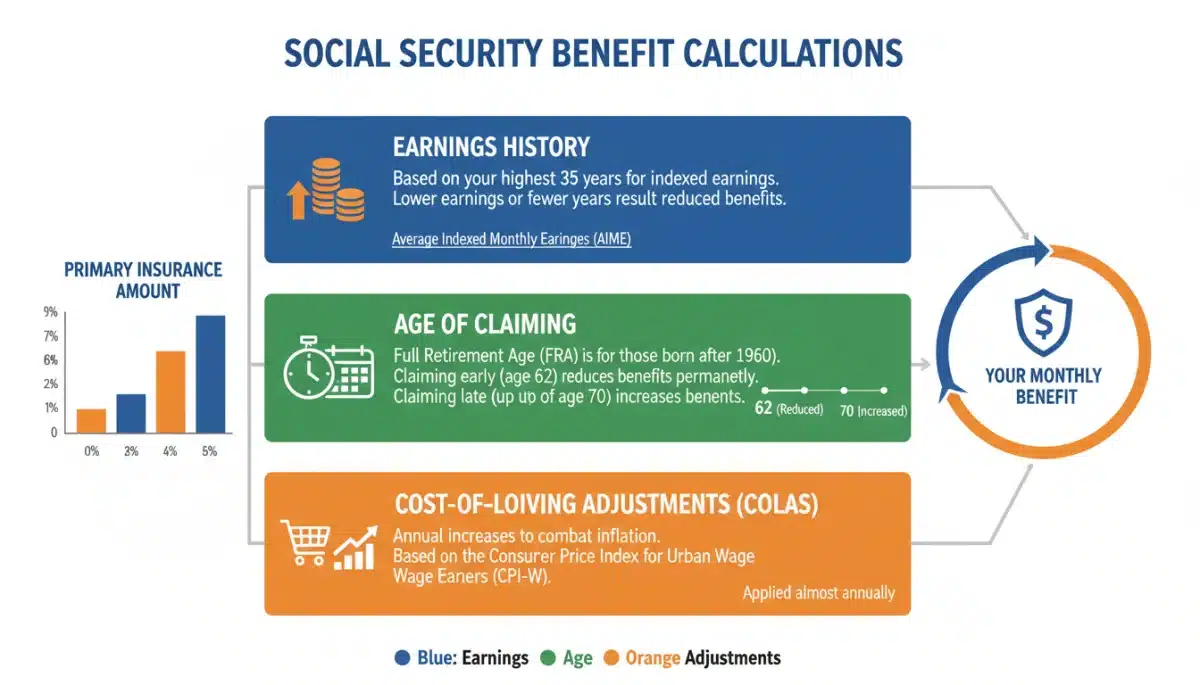
- Full Retirement Age (FRA): Your FRA is the age at which you are entitled to 100% of your primary insurance amount (PIA). For those born in 1960 or later, the FRA is 67. Claiming benefits before your FRA results in a permanent reduction, while delaying past it can increase your monthly payout.
- Earnings History: Your Social Security benefit is calculated based on your 35 highest-earning years. A consistent work history with higher earnings generally translates to a larger benefit.
Understanding these foundational aspects is the first step in effectively planning for your 2026 Social Security benefits. The interplay of these elements will directly influence the amount you receive, underscoring the importance of personalized planning.
Anticipated Changes and Economic Outlook for 2026
Predicting the exact landscape of Social Security benefits for 2026 involves analyzing current economic trends and legislative discussions. While definitive figures are still some time away, we can make informed projections based on historical patterns and ongoing policy considerations. These forecasts are crucial for individuals to adjust their retirement strategies proactively.
Economic indicators such as inflation rates, wage growth, and employment figures play a significant role in determining the annual cost-of-living adjustment (COLA) and the Social Security taxable earnings limit. A robust economy with higher wage growth could lead to more substantial benefit increases, while periods of economic stagnation might result in more modest adjustments.
Inflation and COLA Projections
The Cost-of-Living Adjustment (COLA) is a critical component of Social Security benefits, designed to help beneficiaries maintain their purchasing power. For 2026, the COLA will be determined by the Consumer Price Index for Urban Wage Earners and Clerical Workers (CPI-W) during the third quarter of 2025. While specific predictions are speculative, analyzing current inflation trends provides some insight.
- Current Economic Environment: Persistent inflation could lead to a higher COLA, while a cooling economy might result in a lower adjustment.
- Historical Context: Reviewing past COLA percentages can offer a general idea, but each year’s adjustment is unique to its economic conditions.
- Expert Forecasts: Various economic organizations and governmental bodies often release projections, which can serve as valuable guidance for planning.
Staying informed about these projections as they become available will be key to accurately estimating your 2026 Social Security benefits. These adjustments directly impact the monthly income received by millions of retirees.
Strategy 1: Optimizing Your Claiming Age
One of the most impactful decisions you will make regarding your Social Security benefits is when to claim them. This choice can significantly alter your total lifetime benefits and should be carefully considered based on your personal financial situation, health, and family history. There isn’t a one-size-fits-all answer, as the optimal claiming age varies greatly from person to person.
Claiming early, at age 62, results in a permanent reduction in your monthly benefit. Conversely, delaying beyond your Full Retirement Age (FRA), up to age 70, can substantially increase your monthly payments due to delayed retirement credits. Understanding this trade-off is fundamental to maximizing your payouts.

Analyzing Your Break-Even Point
The concept of a ‘break-even point’ is crucial when deciding your claiming age. This is the age at which the total cumulative benefits received from delaying your claim catch up to and surpass the total cumulative benefits from claiming early. Calculating your break-even point can help you make an informed decision.
- Early Claiming (Age 62): Provides immediate income but at a reduced rate. This might be suitable if you have health issues, need the income, or have other substantial retirement savings.
- Full Retirement Age (FRA): Offers your full primary insurance amount. This is a common choice for many who want a balance between immediate income and a higher monthly payout.
- Delayed Claiming (Up to Age 70): Maximizes your monthly benefit. This strategy is often favored by those who are healthy, have other income sources, and can afford to wait for a larger monthly check.
The decision to claim early, at FRA, or to delay should align with your overall financial plan and personal circumstances. Consider consulting a financial advisor to run personalized scenarios based on your projected lifespan and financial needs.
Strategy 2: Maximizing Your Earnings Record
Your Social Security benefit is directly tied to your lifetime earnings. The Social Security Administration (SSA) calculates your Primary Insurance Amount (PIA) based on your 35 highest-earning years. This means that consistent, high earnings throughout your career can significantly boost your future benefits. For those still in their working years, focusing on maximizing this earnings record is a powerful strategy.
Even if you’re nearing retirement, there might still be opportunities to improve your earnings record. Every year you work and earn above previous lower-earning years can potentially replace a lower-earning year in your calculation, thereby increasing your average indexed monthly earnings (AIME) and, consequently, your PIA.
Understanding the Earnings Cap and Indexed Earnings
Social Security only taxes earnings up to a certain annual limit, known as the Social Security taxable earnings limit. Earnings above this cap are not subject to Social Security taxes and do not count towards your benefit calculation. It’s also important to understand how past earnings are ‘indexed’ to account for changes in average wages over time.
- Work Longer: If you have fewer than 35 years of earnings, or if some of your earlier earning years were low, working additional years can replace those zeros or lower figures with higher, more recent earnings.
- Increase Income: Actively seeking promotions, taking on additional work, or negotiating higher salaries can directly contribute to a more robust earnings record.
- Monitor Your Earnings Statement: Regularly review your Social Security statement to ensure your earnings are accurately reported. Discrepancies can impact your future benefits.
By strategically managing your earnings throughout your career, you can lay a strong foundation for higher 2026 Social Security benefits. This proactive approach ensures you are contributing optimally to your future financial security.
Strategy 3: Exploring Spousal and Survivor Benefits
Social Security benefits extend beyond individual earnings, offering crucial provisions for spouses and survivors. These benefits can significantly enhance a household’s total income in retirement or after the loss of a loved one. Understanding the eligibility rules and claiming strategies for spousal and survivor benefits is vital, particularly for married couples and those who have been widowed.
These benefits are not automatically applied; they often require specific actions and decisions. Strategic coordination between spouses can lead to a higher combined benefit amount over their lifetimes. Similarly, understanding survivor benefits can provide much-needed financial stability during a difficult time.
Coordinating Benefits for Married Couples
Married couples have unique opportunities to optimize their combined Social Security benefits. There are various strategies that can be employed, often involving one spouse delaying their claim while the other claims spousal benefits.
- Spousal Benefits: A spouse can claim up to 50% of the higher-earning spouse’s Full Retirement Age (FRA) benefit. This can be particularly advantageous if one spouse has a significantly lower earnings record or no earnings history.
- File and Suspend (Phased Out): While the ‘file and suspend’ strategy has largely been phased out, understanding its historical context can inform discussions about current spousal benefit strategies.
- Survivor Benefits: A surviving spouse can receive up to 100% of the deceased spouse’s benefit. The claiming age for survivor benefits can also impact the amount received, with higher benefits generally available by delaying until FRA.
Careful planning and communication between spouses are essential to leverage these provisions effectively. Exploring these options can lead to a more secure financial future for both partners, maximizing their collective 2026 Social Security benefits.
Navigating Complex Scenarios and Seeking Expert Advice
While the general principles of Social Security are straightforward, individual situations can introduce significant complexities. Factors such as divorce, government pensions, or disability can alter eligibility and benefit amounts. Understanding how these specific circumstances interact with Social Security rules is crucial for accurate planning and avoiding unexpected shortfalls.
For instance, individuals who worked under a government pension plan that did not contribute to Social Security may be subject to the Windfall Elimination Provision (WEP) or the Government Pension Offset (GPO), which can reduce their Social Security benefits or spousal/survivor benefits, respectively. Similarly, individuals who have been divorced but were married for at least 10 years may be eligible for benefits on their ex-spouse’s record.
When to Consult a Financial Advisor
Given the intricacies of Social Security, especially when combined with personal financial goals and other retirement assets, seeking professional guidance can be invaluable. A qualified financial advisor specializing in retirement planning can offer personalized strategies tailored to your unique situation.
- Personalized Projections: Advisors can help you calculate various claiming scenarios, showing the long-term impact on your total benefits.
- Integrated Planning: They can integrate your Social Security strategy with your other retirement savings, investments, and estate planning.
- Staying Updated: Financial professionals are typically well-versed in the latest Social Security rules and any potential legislative changes, providing up-to-date advice.
Engaging with an expert can provide peace of mind and ensure you are making the most informed decisions possible regarding your 2026 Social Security benefits. Their expertise can uncover opportunities you might overlook and help mitigate potential risks.
| Key Strategy | Brief Description |
|---|---|
| Optimize Claiming Age | Decide whether to claim early (62), at Full Retirement Age (FRA), or delay (up to 70) for higher monthly benefits. |
| Maximize Earnings Record | Increase income and work longer to improve the 35 highest-earning years calculation for higher benefits. |
| Explore Spousal/Survivor Benefits | Strategically coordinate benefits with a spouse or understand survivor options for enhanced household income. |
| Seek Expert Advice | Consult a financial advisor for personalized strategies and to navigate complex individual scenarios effectively. |
Frequently Asked Questions About 2026 Social Security Benefits
The exact COLA for 2026 will be announced in October 2025, based on inflation data from the third quarter of that year. While no official projections are available yet, economic conditions leading up to that period will determine the adjustment. It’s advised to monitor official SSA announcements for the most accurate information.
Your claiming age significantly impacts your monthly benefit. Claiming at age 62 results in a permanent reduction, while waiting until your Full Retirement Age (FRA) provides 100% of your primary benefit. Delaying past FRA, up to age 70, can increase your monthly payments by earning delayed retirement credits.
Yes, working longer can increase your benefits. Social Security calculates your benefit based on your 35 highest-earning years. If you work more years, especially at higher wages, you can replace lower-earning years in your record, potentially boosting your overall average indexed monthly earnings and thus your benefit amount.
While legislative discussions about Social Security’s long-term solvency are ongoing, no specific new changes for 2026 have been enacted. Any significant reforms would typically involve extensive debate and public awareness before implementation. It’s important to stay updated through official government sources.
A financial advisor can help by providing personalized benefit projections based on various claiming ages and scenarios. They can also integrate your Social Security strategy with your broader retirement plan, investment portfolio, and tax considerations, ensuring you make the most informed decisions for your financial future.
Conclusion
Navigating the complexities of 2026 Social Security Benefits requires proactive planning and a clear understanding of the factors at play. By optimizing your claiming age, maximizing your earnings record, and exploring spousal and survivor benefits, you can significantly enhance your financial security in retirement. Staying informed about economic forecasts and potential legislative changes is crucial, and seeking expert advice can provide invaluable personalized guidance. Your retirement future depends on these informed decisions, ensuring you receive the maximum benefits you are entitled to.