Optimize Tax-Loss Harvesting 2026: Cut Capital Gains by 20%

Anúncios
Optimizing your tax-loss harvesting strategy in 2026 is crucial for investors aiming to significantly reduce capital gains by up to 20%, leveraging market downturns to minimize tax liabilities and enhance overall portfolio efficiency.
As we look towards the financial landscape of 2026, understanding and implementing an effective tax-loss harvesting 2026 strategy becomes paramount for savvy investors. This powerful technique allows you to strategically sell investments at a loss to offset capital gains, potentially reducing your tax burden by a remarkable 20% or more. Navigating market volatility with a clear tax plan can transform potential setbacks into significant financial advantages.
Anúncios
Anúncios
Understanding the Fundamentals of Tax-Loss Harvesting
Tax-loss harvesting is a strategic financial maneuver that involves selling investments at a loss to offset capital gains realized from other investments. This practice is particularly valuable for investors seeking to minimize their tax liabilities. By converting unrealized losses into realized losses, you can reduce the amount of capital gains tax you owe, and potentially even offset a limited amount of ordinary income.
The core principle behind tax-loss harvesting is to take advantage of market dips. When certain investments underperform, instead of holding onto them indefinitely, an investor can sell them, realize the loss, and then use that loss to reduce their taxable income. This isn’t about avoiding taxes entirely, but rather about optimizing your tax situation within the legal framework.
The Wash-Sale Rule: A Critical Consideration
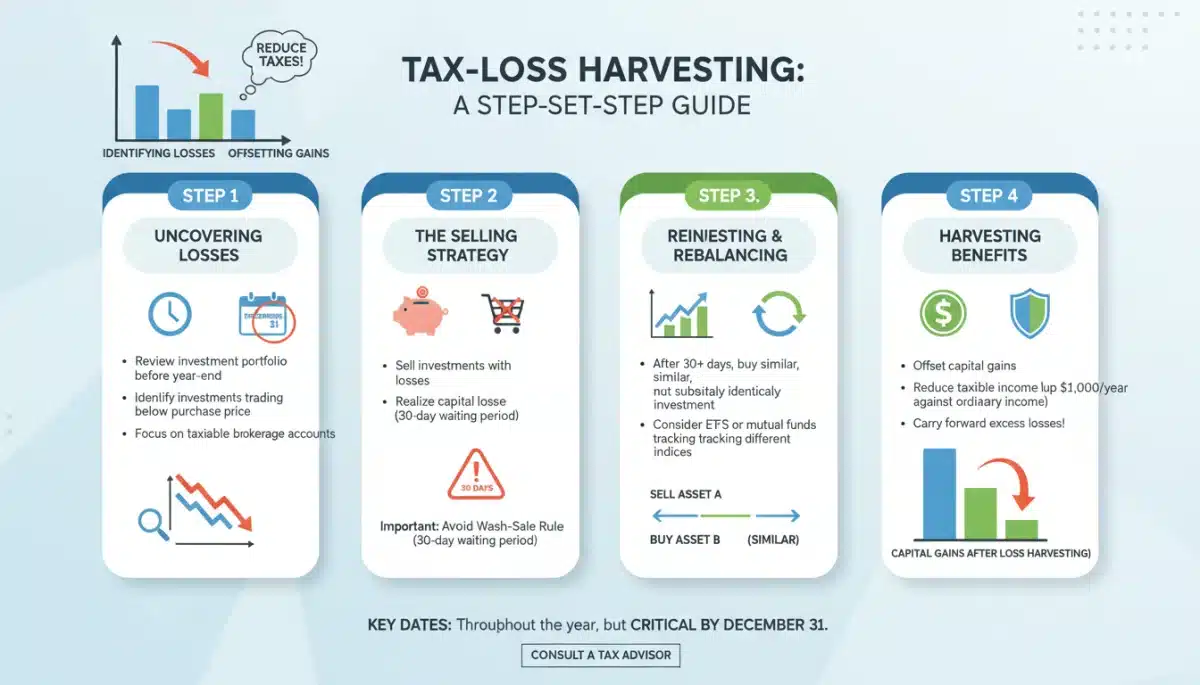
One of the most important rules to understand in tax-loss harvesting is the wash-sale rule. This IRS regulation prevents investors from claiming a loss on a security if they buy a “substantially identical” security within 30 days before or after the sale. Ignoring this rule can negate your tax-loss harvesting efforts and lead to unexpected tax consequences.
- Definition: A security is considered “substantially identical” if it’s the same type of investment, often from the same issuer, or convertible into the same type of investment.
- Purpose: The rule prevents investors from selling a security just to claim a loss, only to immediately repurchase it and maintain their market position.
- Compliance: To avoid a wash sale, ensure you wait at least 31 days before repurchasing the same or a substantially identical security. Alternatively, you can buy a different, but similar, investment to maintain your asset allocation.
Understanding these fundamental rules is the first step towards successfully implementing a tax-loss harvesting strategy. It requires careful planning and a clear understanding of your investment portfolio and tax situation. By adhering to these guidelines, investors can effectively reduce their capital gains and improve their overall financial outlook.
Strategic Implementation for Maximum Impact in 2026
Implementing a tax-loss harvesting strategy effectively in 2026 requires more than just understanding the basics; it demands a strategic approach tailored to your individual financial goals and market conditions. The goal is not just to realize losses, but to do so in a way that maximizes your tax savings while maintaining your desired investment exposure.
One key aspect of strategic implementation is continuous monitoring of your portfolio. Market fluctuations can present opportunities for tax-loss harvesting throughout the year, not just at year-end. Regularly reviewing your investments for unrealized losses can help you identify opportune moments to act.
Identifying Loss Opportunities and Timing
Successful tax-loss harvesting relies on accurate identification of investments that have declined in value. It’s not about selling every losing investment, but rather those that align with your overall portfolio strategy and offer the most significant tax benefits. Timing is also critical; realizing losses earlier in the year can provide more flexibility for reinvestment.
- Diversified Portfolio: A diverse portfolio often provides more opportunities for tax-loss harvesting, as some assets may decline while others perform well.
- Market Downturns: Periods of market volatility or downturns are prime times to look for harvesting opportunities, as more assets are likely to be trading below their purchase price.
- Year-End Review: While year-round monitoring is beneficial, a thorough review towards the end of the year can capture any remaining opportunities before the tax deadline.
After selling an investment at a loss, the funds can be reinvested into a different, non-substantially identical asset to maintain your market exposure. This could involve purchasing an exchange-traded fund (ETF) that tracks a different index or a mutual fund with a similar investment objective but a different portfolio manager. This ensures you don’t miss out on potential market rebounds while still realizing the tax benefits.
Navigating the 2026 Tax Landscape for Investors
The tax landscape is ever-evolving, and staying informed about potential changes and their implications for investors is crucial, especially concerning capital gains and losses in 2026. While specific legislative changes for 2026 are yet to be fully determined, it’s essential to consider current trends and proposed policies that could impact your tax-loss harvesting strategy.
For instance, discussions around capital gains tax rates or potential adjustments to the maximum amount of ordinary income that can be offset by capital losses could influence how investors approach their strategies. Proactive planning based on the most current information available will be key to optimizing your financial outcomes.
Potential Legislative Changes and Their Impact
Investors should keep a close watch on any new tax legislation or proposals that emerge. Changes to tax brackets, capital gains rates, or even the rules surrounding wash sales could significantly alter the effectiveness of traditional tax-loss harvesting approaches. Consulting with a tax professional can help you stay ahead of these potential shifts.
- Capital Gains Rates: Any changes to long-term or short-term capital gains tax rates will directly affect the value of harvested losses.
- Loss Limitations: The current limit for offsetting ordinary income with capital losses is $3,000 per year. Any adjustment to this limit could enhance or diminish the strategy’s benefits.
- IRS Guidance: The IRS may issue new guidance or clarifications on existing rules, impacting how tax-loss harvesting is applied.
Understanding the potential for legislative changes allows investors to build more resilient and adaptable tax strategies. This proactive approach ensures that your tax-loss harvesting efforts remain effective, regardless of how the tax environment evolves. Staying informed and flexible will be your greatest assets.
Advanced Strategies for Enhanced Capital Gains Reduction
Beyond the basic principles, there are advanced strategies that investors can employ to further enhance their capital gains reduction through tax-loss harvesting. These methods often involve a deeper understanding of investment vehicles and a more sophisticated approach to portfolio management. The goal is to maximize the utility of realized losses across various investment types and timeframes.
One such advanced strategy involves coordinating tax-loss harvesting with charitable giving. By donating appreciated securities directly to a qualified charity, you can avoid paying capital gains tax on the appreciation and also claim a charitable deduction. If you also have losses, you can harvest those losses from other investments to offset any remaining gains or ordinary income.
Integrating with Estate Planning and Retirement Accounts
Tax-loss harvesting can also be integrated into broader financial planning, including estate planning and retirement account management. While losses in tax-advantaged retirement accounts generally don’t offer the same direct tax benefits as those in taxable accounts, understanding the interplay can still be advantageous.
- Estate Planning: For heirs, the cost basis of inherited assets is typically stepped up to market value at the time of death, potentially eliminating capital gains. However, losses harvested before death can still be used to offset gains in the decedent’s final tax return.
- Retirement Accounts: While direct tax-loss harvesting isn’t applicable, understanding your overall asset location strategy (which assets to hold in taxable vs. tax-advantaged accounts) can indirectly support tax efficiency.
- Tax-Efficient Rebalancing: When rebalancing your portfolio, prioritize selling losing positions in taxable accounts to realize losses, rather than selling appreciated assets that would trigger gains.
These advanced tactics demonstrate that tax-loss harvesting is not a standalone event but a continuous process that should be woven into the fabric of your comprehensive financial plan. By considering these sophisticated approaches, investors can achieve even greater tax efficiency and financial impact.
Automated Tools and Professional Guidance for 2026
The complexity of tracking market movements, understanding tax rules, and executing timely trades can be daunting for individual investors. Fortunately, the advent of automated tools and the availability of professional financial guidance have made optimizing tax-loss harvesting in 2026 more accessible and efficient than ever before.
Robo-advisors and specialized investment platforms now offer automated tax-loss harvesting features. These tools continuously monitor your portfolio, identify loss opportunities, and execute trades in compliance with wash-sale rules. This can be particularly beneficial for investors with diverse portfolios or those who prefer a hands-off approach to investment management.
The Role of Financial Advisors and Tax Professionals
While automated tools provide convenience, the nuanced nature of tax planning often benefits from the expertise of financial advisors and tax professionals. These experts can offer personalized advice, integrate tax-loss harvesting into your broader financial strategy, and ensure compliance with the latest tax regulations.
- Personalized Strategy: Advisors can tailor a tax-loss harvesting plan to your specific income, investment goals, and risk tolerance.
- Compliance Assurance: Tax professionals ensure that all harvesting activities comply with IRS rules, minimizing the risk of penalties or audits.
- Holistic Planning: They can integrate tax-loss harvesting with other financial strategies, such as retirement planning, estate planning, and charitable giving, for maximum benefit.
Leveraging both technology and professional expertise can significantly enhance your ability to effectively manage capital gains and losses. For investors aiming to reduce their capital gains by 20% or more, this dual approach provides both efficiency and peace of mind, ensuring that your strategies are both optimized and compliant.
Measuring and Maximizing Your 20% Capital Gains Reduction Goal
Setting a target, such as a 20% reduction in capital gains through tax-loss harvesting, is an excellent way to focus your efforts. However, achieving and measuring this goal requires a clear understanding of your current capital gains position, meticulous record-keeping, and consistent application of your harvesting strategy. It’s about turning a theoretical benefit into a tangible financial impact.
Begin by accurately assessing your realized capital gains for the year. This involves reviewing all sales of appreciated assets. Once you have a clear picture of your gains, you can then identify potential losses within your portfolio that can be harvested to offset these gains. The objective is to match losses against gains to minimize your taxable income.
Tracking Your Progress and Adjusting Strategies
Effective measurement isn’t a one-time event; it’s an ongoing process. Throughout the year, and especially as year-end approaches, track the losses you’ve realized and how they’ve impacted your capital gains. This allows for timely adjustments to your strategy, ensuring you stay on track to meet your 20% reduction target.
- Detailed Records: Maintain meticulous records of all buy and sell dates, cost bases, and realized gains or losses for each investment.
- Regular Reviews: Conduct quarterly or semi-annual reviews of your portfolio to identify new harvesting opportunities or assess the effectiveness of past actions.
- Tax Software Utilization: Use tax software or consult with a tax professional to accurately calculate the impact of your tax-loss harvesting on your overall tax liability.
By diligently measuring your progress and being prepared to adjust your strategies, you can significantly increase your chances of achieving your goal of reducing capital gains by 20% or more in 2026. This systematic approach transforms tax-loss harvesting from a reactive measure into a powerful, proactive financial planning tool.
| Key Point | Brief Description |
|---|---|
| Wash-Sale Rule | Prevents claiming a loss if a substantially identical security is bought within 30 days. |
| Strategic Timing | Identify and realize losses throughout the year, not just at year-end, for maximum flexibility. |
| Legislative Watch | Stay informed on 2026 tax law changes affecting capital gains and loss limitations. |
| Automated Tools | Utilize robo-advisors for efficient, compliant, and continuous tax-loss harvesting. |
Frequently Asked Questions About Tax-Loss Harvesting in 2026
Tax-loss harvesting involves selling investments at a loss to offset capital gains from other investments, thus reducing your taxable income. For 2026, this strategy can significantly lower your capital gains tax liability, potentially by 20% or more, by strategically realizing losses in your portfolio.
The wash-sale rule prohibits claiming a loss if you repurchase the same or a “substantially identical” security within 30 days before or after the sale. To avoid this, you must wait 31 days or buy a different, yet similar, investment to maintain market exposure while still realizing the tax loss.
Yes, after offsetting all capital gains, you can use up to $3,000 of remaining capital losses each year to offset ordinary income. Any losses exceeding this amount can be carried forward indefinitely to offset future capital gains or ordinary income.
While year-end is a common time, opportunities can arise throughout the year, especially during periods of market volatility or downturns. Continuous monitoring of your portfolio allows for timely identification and execution of tax-loss harvesting, maximizing its potential benefits.
Both options have merits. Automated tools offer efficiency and compliance for straightforward cases. For complex portfolios or integrated financial planning, a financial advisor provides personalized strategies and ensures adherence to evolving tax laws, offering a comprehensive approach to tax efficiency.
Conclusion
Optimizing your tax-loss harvesting strategy in 2026 is not merely a tactical maneuver but a fundamental component of sophisticated financial planning. By understanding the rules, employing strategic timing, staying abreast of legislative changes, and leveraging both technology and professional advice, investors can effectively reduce their capital gains by a significant margin. This proactive approach not only minimizes tax liabilities but also enhances overall portfolio efficiency, transforming market volatility into a powerful tool for wealth management. Embracing these strategies will undoubtedly contribute to a more robust and tax-efficient financial future.