Future of Vocational Training in the US: 4 Trends for 2026

Anúncios
The future of vocational training in the US is being reshaped by technological advancements and evolving workforce needs, with four key trends emerging to define its landscape by 2026, ensuring a skilled and adaptable labor force.
The landscape of education and workforce development is in constant flux, but few sectors are experiencing as profound a transformation as vocational training. As industries evolve and new technologies emerge, the demand for specialized skills intensifies. This article delves into the future of vocational training in the US, highlighting four critical emerging trends expected to define its trajectory by 2026, ensuring a robust and adaptable workforce.
Anúncios
The rise of technology-driven learning platforms
The integration of advanced technology into vocational training programs is no longer a distant concept; it’s becoming a present reality. By 2026, technology-driven learning platforms will be central to how vocational skills are acquired and refined. These platforms offer unparalleled flexibility and access, breaking down traditional barriers to education.
Anúncios
This shift is not merely about digitizing existing content; it involves a fundamental reimagining of instructional delivery, leveraging tools that enhance engagement and practical application. From virtual reality simulations to AI-powered personalized learning paths, technology is making vocational education more immersive and effective than ever before.
Virtual and augmented reality for immersive training
Virtual Reality (VR) and Augmented Reality (AR) are poised to revolutionize vocational training by providing realistic, risk-free environments for skill development. Trainees can practice complex procedures, operate heavy machinery, or perform intricate repairs without the need for expensive physical equipment or dangerous real-world scenarios.
- Enhanced safety: Trainees can make mistakes in a virtual environment without real-world consequences.
- Cost reduction: Decreases the need for physical equipment and consumables.
- Accessibility: Allows remote access to specialized training modules.
- Standardized practice: Ensures consistent learning experiences across all trainees.
These immersive technologies allow for repeated practice and immediate feedback, accelerating the learning curve and building confidence. The ability to simulate diverse work conditions also prepares students for a wider range of challenges they might encounter in their careers.
AI-powered personalized learning paths
Artificial Intelligence (AI) is transforming vocational training by enabling highly personalized learning experiences. AI algorithms can analyze a student’s performance, identify areas of weakness, and recommend tailored resources or exercises. This adaptive approach ensures that each learner progresses at their own pace, focusing on what they need most.
Personalized learning also means that training content can be updated in real-time to reflect the latest industry standards and technological advancements. This agility is crucial in fast-evolving fields, ensuring that graduates are always equipped with the most current and relevant skills.
The adoption of technology-driven learning platforms marks a significant evolution in vocational training, moving towards more engaging, accessible, and effective educational models. These innovations are critical for preparing a workforce capable of navigating the complexities of modern industries.
Emphasis on skills-based learning and micro-credentials
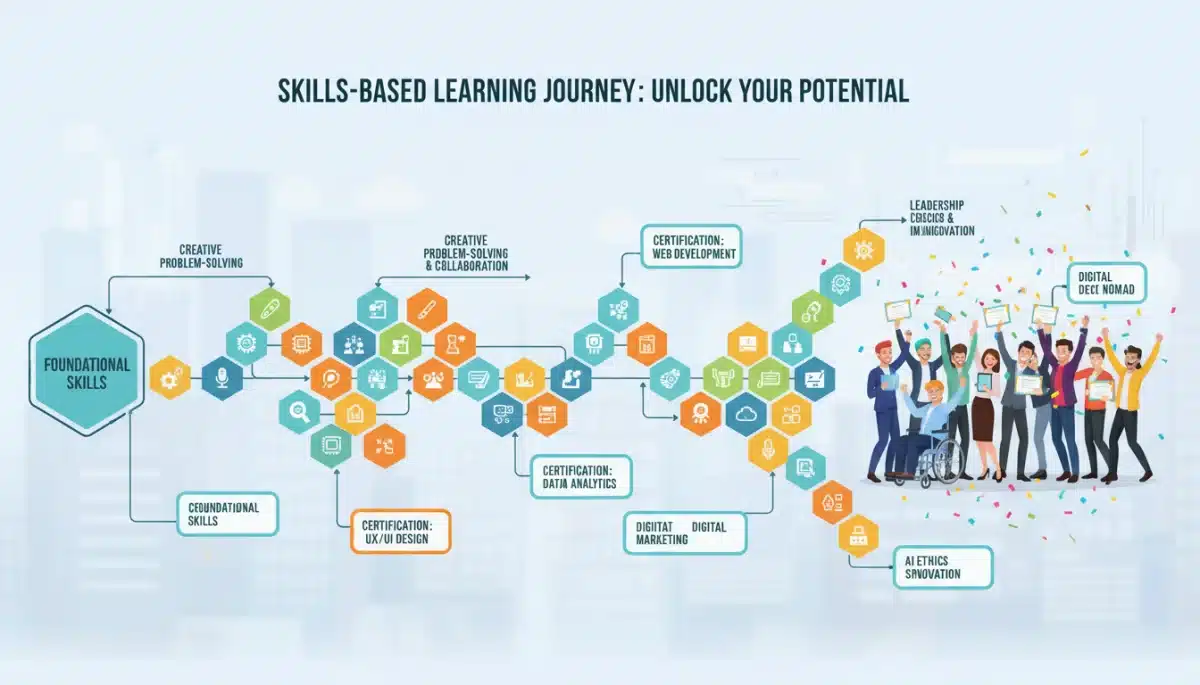
The traditional model of lengthy degree programs is increasingly being challenged by the demand for rapid, targeted skill acquisition. By 2026, vocational training will place a much stronger emphasis on skills-based learning, leading to the proliferation of micro-credentials. This approach directly addresses the immediate needs of employers and provides learners with flexible pathways to career advancement.
Instead of focusing solely on broad academic qualifications, vocational programs are now breaking down complex roles into individual, verifiable skills. This allows individuals to acquire specific competencies quickly and demonstrate their readiness for particular job functions.
Breaking down skills for targeted training
Skills-based learning involves identifying the precise competencies required for a job and designing training modules around those specific skills. This granular approach ensures that every minute of training is relevant and directly applicable to real-world tasks. Employers benefit from a workforce that is immediately productive, while learners gain valuable skills without unnecessary overhead.
- Direct job relevance: Training aligns precisely with employer needs.
- Faster entry to workforce: Shorter training periods mean quicker employment.
- Adaptability: Learners can easily update specific skills as industry demands change.
- Clear learning outcomes: Each module targets a measurable skill.
This method also supports continuous learning, as individuals can stack micro-credentials over time to build a comprehensive skill set tailored to their career aspirations.
The rise of micro-credentials and digital badges
Micro-credentials and digital badges are becoming the new currency of vocational achievement. These verifiable, digital representations of specific skills or competencies offer a transparent way for individuals to showcase their qualifications. They are typically awarded upon completion of short, focused training programs or demonstration of mastery in a particular area.
These credentials provide employers with a clear understanding of an applicant’s capabilities, moving beyond general degrees to specific, validated skills. For learners, micro-credentials offer a flexible and affordable way to upskill or reskill, making education more accessible and responsive to market demands.
The shift towards skills-based learning and micro-credentials reflects a broader recognition that the modern workforce requires agility and continuous adaptation. Vocational training is at the forefront of this movement, providing practical solutions for both individuals and industries.
Strengthened industry partnerships and apprenticeships
Collaboration between educational institutions and industries is becoming increasingly vital for the success of vocational training. By 2026, we will see a significant strengthening of these partnerships, with apprenticeships playing a central role in bridging the gap between learning and earning. These collaborations ensure that training programs are aligned with industry needs and that graduates are job-ready from day one.
Industry involvement goes beyond providing input; it extends to co-designing curricula, offering real-world training opportunities, and directly hiring program graduates. This symbiotic relationship benefits all parties involved, creating a pipeline of skilled talent for businesses and clear career paths for students.
Curriculum co-development with industry leaders
For vocational training to remain relevant, its curriculum must reflect the current and future demands of the job market. Industry leaders are increasingly involved in co-developing training programs, ensuring that the skills taught are precisely what businesses need. This collaborative approach prevents skills gaps and ensures that training investments yield a high return.
Working directly with employers allows educational institutions to integrate new technologies, processes, and best practices into their programs as soon as they emerge. This agility is critical in sectors experiencing rapid technological change, such as manufacturing, IT, and healthcare.
Expansion of apprenticeship programs
Apprenticeships are experiencing a renaissance, recognized as a highly effective model for vocational training. These programs combine on-the-job training with classroom instruction, allowing individuals to earn wages while acquiring valuable skills. By 2026, apprenticeships are expected to expand significantly across various sectors, moving beyond traditional trades into areas like IT, healthcare, and advanced manufacturing.
- Earn while you learn: Apprentices receive compensation, reducing financial barriers.
- Guaranteed employment: Many apprenticeships lead directly to full-time positions.
- Practical experience: Hands-on training in real work environments.
- Industry-recognized credentials: Apprenticeships often culminate in certifications.
The expansion of apprenticeships is a testament to their effectiveness in producing highly skilled, motivated workers who are deeply familiar with their chosen industry. They represent a win-win for both learners and employers.
Stronger industry partnerships and expanded apprenticeships are fundamental to ensuring that vocational training remains responsive and effective. These collaborations are building a more robust and adaptable workforce for the future.
Focus on soft skills and adaptability
While technical proficiency remains crucial, the modern workplace increasingly values a range of soft skills that enable individuals to thrive in dynamic environments. By 2026, vocational training programs will place a greater emphasis on developing these essential human capabilities, alongside technical expertise. Adaptability, critical thinking, and communication are becoming just as important as hands-on technical skills.
The rapid pace of technological change means that specific technical skills can become obsolete quickly. Therefore, the ability to learn new skills, solve complex problems, and collaborate effectively is paramount for long-term career success.
Cultivating critical thinking and problem-solving
Vocational training programs are evolving to incorporate more opportunities for students to engage in critical thinking and problem-solving. This moves beyond rote memorization of procedures to understanding underlying principles and applying them to novel situations. Employers seek individuals who can analyze challenges, innovate solutions, and adapt to unforeseen circumstances.
- Scenario-based learning: Students tackle realistic workplace problems.
- Project-based assignments: Encourages independent thought and solution development.
- Case studies: Develops analytical skills through examination of real-world examples.
These approaches help graduates not just to perform tasks, but to understand the ‘why’ behind them, making them more effective and resilient professionals.
Enhancing communication and teamwork abilities
Effective communication and the ability to work collaboratively are indispensable in virtually every professional setting. Vocational programs are integrating more group projects, presentations, and client interaction simulations to hone these vital soft skills. Graduates who can clearly articulate ideas, listen actively, and contribute positively to a team are highly sought after by employers.
Team-based training mirrors the collaborative nature of modern workplaces, preparing students for environments where interdisciplinary cooperation is key. The ability to communicate technical information to diverse audiences, from colleagues to clients, is also a critical skill being emphasized.
The holistic development of both technical and soft skills ensures that vocational training graduates are not only competent in their craft but also adaptable, effective communicators, and valuable team members, ready for the challenges of 2026 and beyond.
Increased accessibility and flexible delivery models
Accessibility is a cornerstone of modern education, and vocational training is no exception. By 2026, there will be a significant expansion in flexible delivery models, making vocational education more available to a wider range of individuals, including working adults, rural populations, and those with diverse learning needs. This trend is driven by technological advancements and a commitment to lifelong learning.
The goal is to remove barriers to entry, ensuring that anyone who desires to acquire valuable skills can do so, regardless of their geographical location, financial situation, or personal schedule. This democratizes access to career-advancing opportunities.
Online and hybrid learning options
The proliferation of online and hybrid learning models has dramatically increased the accessibility of vocational training. Online courses allow students to learn at their own pace and from any location, making it possible to balance education with work and family commitments. Hybrid models combine the flexibility of online learning with essential hands-on experience in physical labs or workshops.
- Geographic flexibility: Learners can access programs from anywhere.
- Scheduling convenience: Adaptable to diverse personal and professional schedules.
- Reduced commuting costs: Saves time and money on travel.
- Self-paced learning: Accommodates different learning speeds and styles.
These flexible options are particularly beneficial for adult learners seeking to upskill or reskill without interrupting their current employment.
Modular programs and stackable credentials
To further enhance flexibility, vocational training is moving towards modular programs and stackable credentials. Instead of committing to a lengthy, comprehensive program, individuals can enroll in smaller, focused modules that lead to specific certifications. These modules can then be ‘stacked’ together to build more extensive qualifications over time.
This modular approach allows learners to acquire skills incrementally, entering the workforce sooner with foundational competencies and then continuing their education as their career progresses. It also provides greater financial flexibility, as students can pay for smaller segments of training rather than a large upfront cost.
Increased accessibility and flexible delivery models are crucial for fostering a culture of lifelong learning and ensuring that vocational training can meet the evolving needs of a diverse workforce. These innovations are making skill development more attainable for everyone.
Addressing the evolving workforce demands
The American workforce is undergoing a profound transformation, driven by automation, artificial intelligence, and global economic shifts. Vocational training programs are uniquely positioned to address these evolving demands by preparing individuals for the jobs of today and tomorrow. By 2026, vocational education will be even more critical in closing skills gaps and fostering economic resilience.
This involves not only adapting existing programs but also anticipating future needs and developing entirely new curricula. The responsiveness of vocational training is key to maintaining a competitive and productive national workforce.
Future-proofing skills for automation and AI
As automation and AI continue to reshape industries, many routine tasks are being taken over by machines. This necessitates a shift in human skills towards areas that require creativity, critical thinking, complex problem-solving, and interpersonal communication—skills that are difficult for machines to replicate. Vocational training is adapting by focusing on these ‘future-proof’ competencies.
- Robotics maintenance: Training for technicians to manage automated systems.
- Data analysis: Equipping workers to interpret and act on data generated by AI.
- Human-machine collaboration: Developing skills for working alongside intelligent systems.
- Ethical AI considerations: Educating on the responsible deployment of new technologies.
By emphasizing these skills, vocational programs ensure that graduates remain valuable assets in an increasingly automated world.
Bridging the manufacturing and tech skills gap
Despite technological advancements, many sectors, particularly advanced manufacturing and technology, face significant skills gaps. Vocational training is actively working to bridge these gaps by providing targeted education in areas like mechatronics, cybersecurity, software development, and digital fabrication. These programs are designed to meet the specific talent needs of these growing industries.
The collaboration with industry partners ensures that training is directly aligned with the technologies and processes used in cutting-edge companies. This direct pipeline of skilled workers is essential for maintaining America’s competitive edge in global markets.
Addressing evolving workforce demands is at the core of vocational training’s mission. By anticipating and responding to industrial shifts, these programs ensure a continuous supply of skilled professionals, driving innovation and economic growth across the US.
The impact on economic growth and social equity
The advancements in vocational training are not just about individual career paths; they have significant implications for broader economic growth and social equity across the US. By 2026, a modernized vocational training system will play a crucial role in creating a more inclusive and prosperous society. It provides pathways to well-paying jobs for individuals who might not pursue traditional four-year degrees, fostering upward mobility.
Investing in robust vocational programs strengthens local economies by ensuring a steady supply of skilled labor for essential industries. This in turn attracts new businesses and encourages existing ones to expand, creating a virtuous cycle of growth and opportunity.
Creating pathways to high-demand careers
Vocational training is uniquely positioned to connect individuals directly to high-demand careers that offer competitive wages and opportunities for advancement. From skilled trades to healthcare support and IT, these programs equip learners with the practical expertise needed to fill critical roles in the economy. This direct linkage to employment helps alleviate skills shortages in various sectors.
- Direct industry alignment: Programs are built around specific job market needs.
- Reduced student debt: Shorter, more affordable programs compared to traditional degrees.
- Immediate employment prospects: Graduates often find jobs quickly after training.
- Career stability: Many vocational fields offer resilient job markets.
By focusing on these pathways, vocational training helps individuals achieve economic security and contributes to a more stable and productive workforce.
Promoting social mobility and inclusivity
Vocational training serves as a powerful engine for social mobility, offering accessible routes to middle-class careers for diverse populations. It provides opportunities for individuals from underserved communities, those seeking career changes, or those who prefer hands-on learning, to acquire valuable skills and improve their economic standing. This inclusivity is vital for building a more equitable society.
By making education more practical and responsive to individual needs, vocational training helps reduce educational disparities and ensures that a wider segment of the population can participate in and benefit from economic prosperity. It acknowledges that not all learning happens in a traditional university setting, validating diverse pathways to success.
Ultimately, the evolution of vocational training is a critical component of a healthy economy and a fair society. Its ability to adapt and provide relevant, accessible education will be key to unlocking potential and driving progress in the years leading up to and beyond 2026.
| Key Trend | Brief Description |
|---|---|
| Tech-Driven Learning | Integration of VR/AR and AI for immersive and personalized training experiences. |
| Skills-Based Focus | Emphasis on micro-credentials and targeted skill acquisition for rapid workforce entry. |
| Industry Partnerships | Strengthened collaborations and expanded apprenticeships to align training with employer needs. |
| Soft Skills & Adaptability | Increased development of critical thinking, communication, and problem-solving alongside technical skills. |
Frequently asked questions about vocational training’s future
By 2026, technology will profoundly transform vocational training through widespread adoption of VR/AR for immersive simulations and AI for personalized learning paths. These innovations will make training more engaging, accessible, and tailored to individual needs, preparing students for technologically advanced workplaces.
Micro-credentials are verifiable digital badges or certificates that confirm mastery of specific, targeted skills. They are crucial because they offer flexible, shorter pathways to skill acquisition, directly addressing employer needs and allowing individuals to quickly upskill or reskill for in-demand jobs without lengthy traditional degrees.
Industry partnerships will strengthen significantly by 2026, involving closer collaboration in curriculum co-development and expanded apprenticeships to align training with current and future industry demands, producing job-ready graduates and fostering economic growth through a skilled workforce.
The modern workplace demands more than just technical skills; it requires adaptability, critical thinking, problem-solving, and strong communication. Vocational training is increasingly emphasizing these soft skills because they are crucial for navigating rapidly changing work environments, fostering innovation, and ensuring long-term career success for graduates.
Vocational training promotes social equity by providing accessible and affordable pathways to high-demand careers for diverse populations, including those from underserved communities. It offers practical, skills-focused education that can lead to immediate employment and upward economic mobility, reducing disparities and broadening participation in the workforce.
Conclusion
The future of vocational training in the US is characterized by dynamic adaptation and innovation. The four emerging trends—technology-driven learning, skills-based approaches, strengthened industry partnerships, and a focus on soft skills—collectively paint a picture of a sector that is more responsive, accessible, and effective than ever before. By embracing these changes, vocational training is poised to not only meet the evolving demands of the American workforce but also to drive economic growth and enhance social equity, creating a more skilled and resilient populace for 2026 and beyond.